
Why it matters when buying land
Many development projects only work at a certain site size. A retail pad, a subdivision, or a solar farm may need 5, 50, or 500 contiguous acres — and the only way to get there is buying several neighboring parcels from different owners.
Assemblage is where some of the largest land profits are made, because a successfully combined site can be worth far more per acre than the pieces were individually. It is also where deals die: a single holdout owner in the middle of your footprint can sink the whole plan.
For smaller buyers, the same logic applies at modest scale — adding a neighboring lot can turn an unbuildable sliver into a buildable site, or give a landlocked parcel road frontage.
How to check it
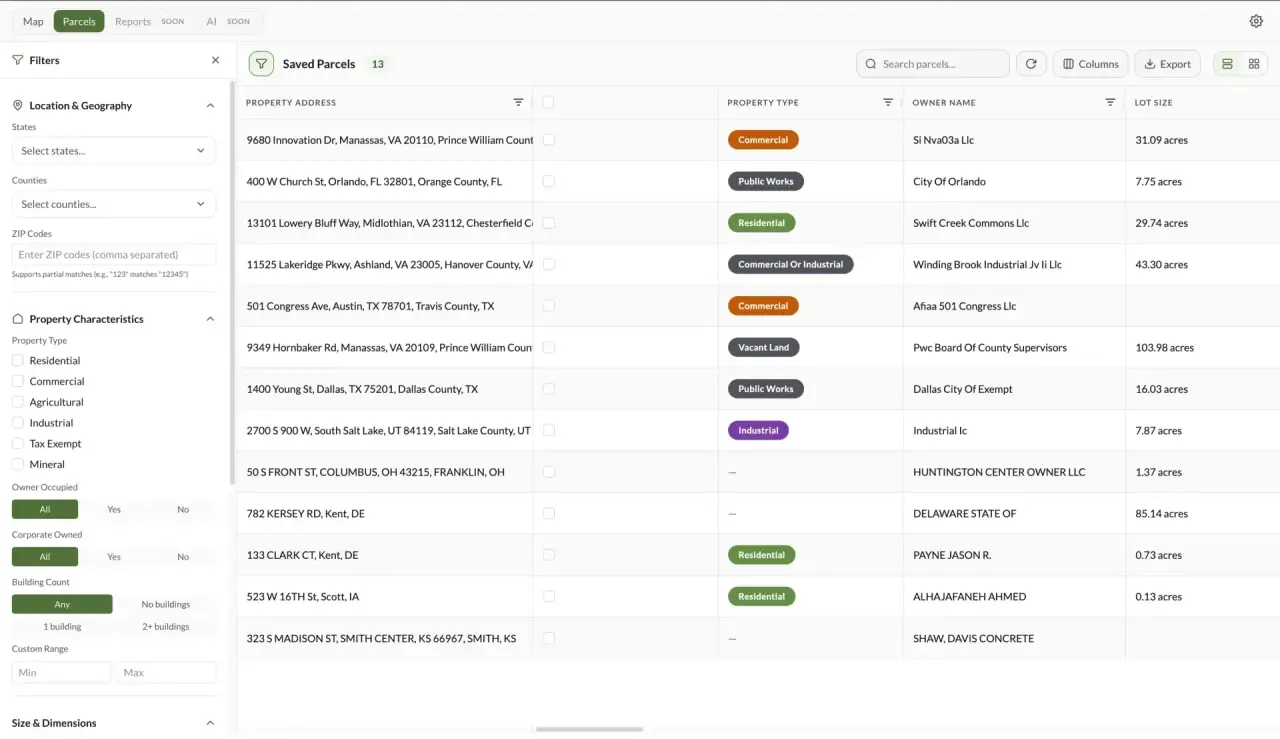
Map the footprint you need, then identify every parcel inside it and who owns each one. In Land Owl, the parcel boundaries on the map show exactly how adjacent parcels fit together, and parcel ownership data tells you who owns each piece — including when several parcels share a common owner, which can simplify negotiations.
Check the zoning layer for each parcel: an assemblage that spans two zoning districts may need a rezoning or may not work at all.
Before closing on any piece, confirm with the county how parcels are legally combined (often a lot merger or replat) and verify there are no deed restrictions or easements that would defeat the combined use.
See it on a real parcel
Land Owl overlays zoning, ownership, flood risk, and more on every parcel — before you commit a dollar.
What is plottage value?
Plottage is the increment of value created when assembled parcels are worth more together than separately. A classic example: four quarter-acre infill lots worth $50,000 each might be worth $400,000 as a single one-acre commercial site — the extra $200,000 is plottage.
Plottage exists because larger sites unlock higher and better uses: bigger buildings, required parking, stormwater areas, or minimum site sizes set by zoning.
How do you assemble parcels without driving up prices?
Experienced assemblers move quietly and in parallel, often using option contracts that lock in a price without obligating them to buy until the whole footprint is secured. If owners learn a developer needs their specific parcel, asking prices tend to rise sharply.
Options, confidentiality, buying through separate entities, and having fallback site layouts that work without any single parcel are the standard tools for managing holdout risk.
What are the risks of land assemblage?
Holdouts are the headline risk — one unwilling owner can leave you holding several parcels that no longer add up to a usable site. Closing on pieces before the footprint is complete concentrates that risk.
Other risks include zoning that does not permit the intended combined use, environmental problems on one parcel contaminating the economics of the whole site, and title defects or easements that fragment the assembled land. Thorough due diligence on every parcel, not just the biggest one, is essential.
Is assemblage the same as a lot merger or replat?
No — assemblage is the acquisition strategy; a lot merger or replat is the legal mechanism that formally combines the parcels afterward. Buying adjacent parcels does not automatically merge them: each keeps its own parcel number, tax bill, and legal description until you record a combination with the county.
Whether and how to merge depends on the plan. Keeping parcels legally separate preserves flexibility to sell pieces later, while merging may be required for a single building that crosses the old lot lines.