Why it matters when buying land
The same acre can be worth several times more improved than unimproved, because improvements represent money already spent and risk already retired. A lot with water, power, sewer, and a driveway is close to build-ready; raw land may need tens of thousands of dollars of work before a foundation can be poured.
Financing follows the same logic. Lenders see raw land as the riskiest collateral, so unimproved land loans typically carry larger down payments and higher rates than loans on improved lots — and some lenders will not touch raw land at all.
The trap for buyers is partial improvement: a “lot with utilities nearby” may still face long, expensive connections, and an old well or failed septic can be a liability rather than an asset. Always price the gap between the land's current state and the state you need.
How to check it
Make a checklist of what your use requires — road access, electric, water (municipal or well), sewer or septic, grading, drainage — and verify each item on the ground and with the providers. “Power at the road” means little until the utility quotes the connection.
Ask the utility companies and the county health department directly: line locations, connection fees, and septic feasibility (often requiring a perc test) are facts you can confirm before closing.
The listing and the assessor's records both classify the property, and the assessor separately values land and improvements — a quick way to see what the county thinks is on the parcel. Then walk the land; records lag reality in both directions.
See it on a real parcel
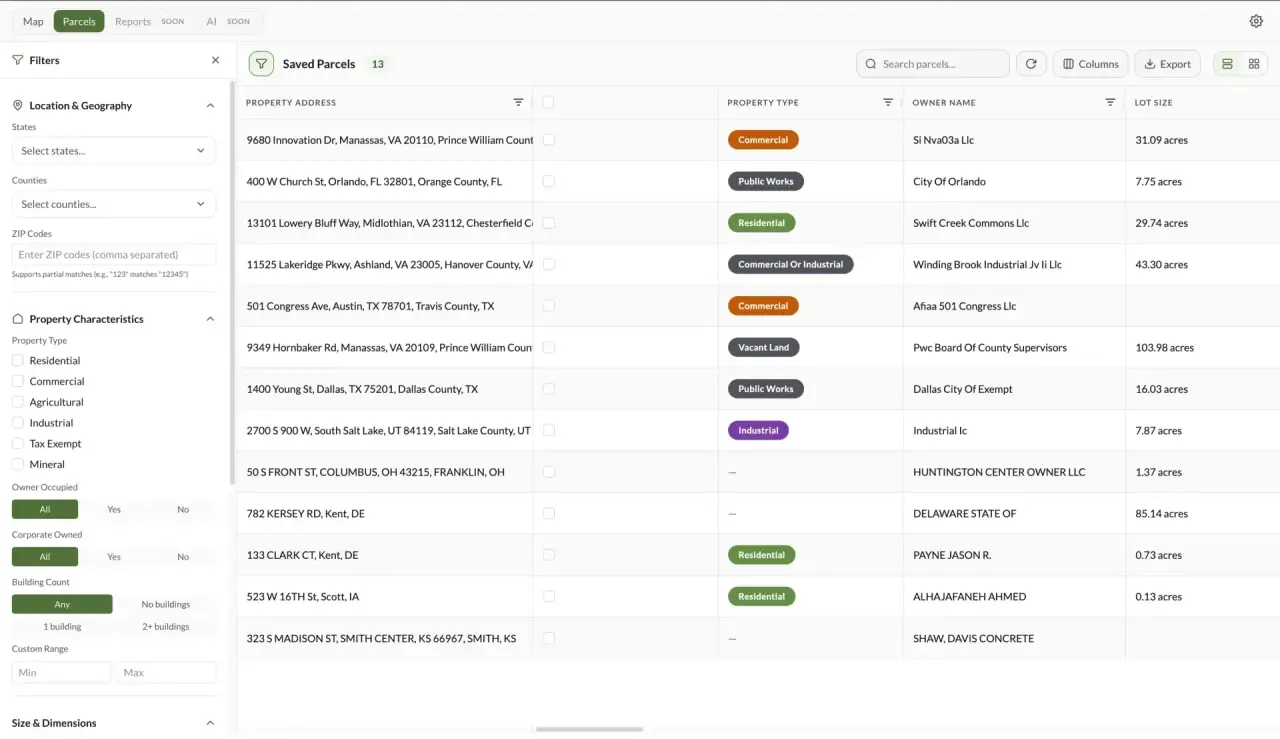
Land Owl overlays zoning, ownership, flood risk, and more on every parcel — before you commit a dollar.
What counts as an improvement to land?
Anything human-made that adds usability or value: buildings, wells, septic systems, utility connections, driveways and interior roads, grading and drainage work, fencing, and cleared or prepared building sites.
Definitions blur at the edges — a parcel with only road frontage and nearby power lines is sometimes marketed as “semi-improved.” For practical purposes, count only improvements that actually reduce the work and cost between you and your intended use.
Is unimproved land cheaper to own?
Usually, on an annual basis. Property taxes are typically lower because there are no improvements to assess, insurance needs are minimal, and there is nothing to maintain.
The trade-off is that raw land produces no income and no shelter while you hold it, and the eventual improvement costs still await. Cheap to hold is not the same as cheap to use.
Is it harder to finance unimproved land?
Yes. Raw land is the hardest real estate to finance: expect down payments commonly in the 20–50% range, shorter terms, and higher interest rates than improved property, with exact terms varying by lender and market.
Common workarounds include local banks and farm credit lenders that know land, seller financing, and paying cash. Improved lots with utilities sit closer to conventional financing terms.
Which is the better investment?
It depends on your capital, timeline, and appetite for work. Unimproved land offers the lower entry price and the largest upside — much of land development profit comes from taking land up the improvement ladder — but it demands time, expertise, and cash for improvements.
Improved land costs more but is closer to usable or rentable, easier to finance, and easier to resell. Many buyers split the difference: partially improved parcels where the riskiest unknowns (access, water, septic feasibility) are already resolved.